
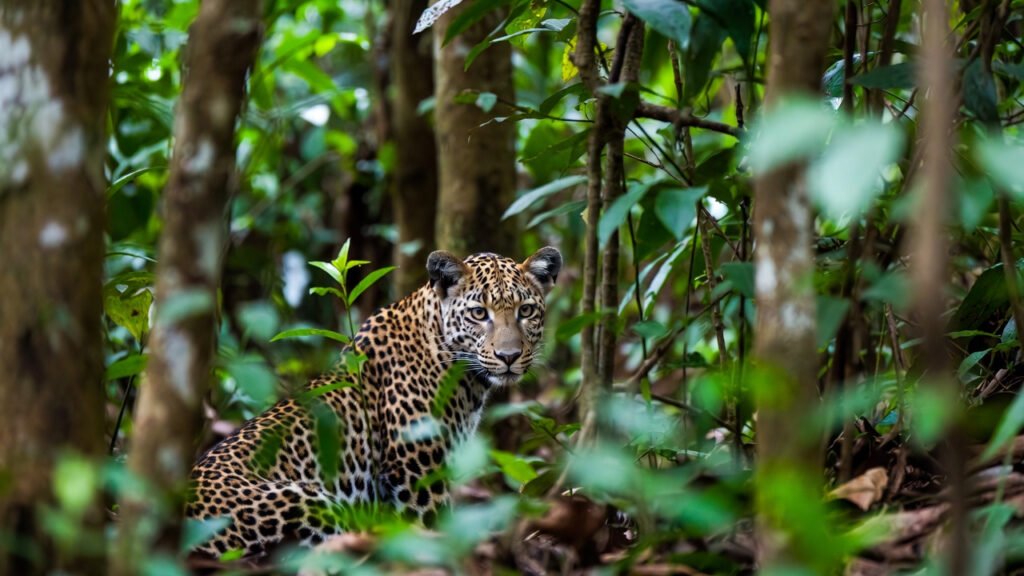
In the southeastern corner of Sri Lanka, where the island’s arid lowlands meet the Indian Ocean, lies one of Asia’s most remarkable wildlife sanctuaries. Yala National Park is a place where leopards stalk through thorny scrubland, elephants gather at ancient watering holes, and the rhythms of nature have remained largely unchanged for millennia.
A Landscape Shaped by Time
Yala’s 979 square kilometers encompass an extraordinary diversity of ecosystems. Thorny scrub jungle dominates much of the landscape, interspersed with grasslands, brackish lagoons, and rocky outcrops that rise dramatically from the flat terrain. Along the coast, golden beaches give way to the azure waters of the Indian Ocean, creating a striking contrast with the dusty interior.
The park’s geology tells a story millions of years in the making. Ancient rock formations dot the landscape, some bearing inscriptions that hint at human presence dating back over two thousand years. These rocks, weathered by wind and rain, now serve as lookout points for leopards surveying their domain and provide shade for resting elephants during the scorching midday heat.
The Leopard’s Kingdom
Yala holds the distinction of having one of the highest leopard densities in the world. While these magnificent cats are notoriously elusive elsewhere, here they’ve adapted to the open terrain, making Yala one of the best places on Earth to observe leopards in the wild. The park is estimated to host around 40 to 50 leopards in its most visited block alone, translating to densities that can reach one leopard per square kilometer in prime habitat.
Unlike their African cousins who must compete with lions for prey, Sri Lankan leopards are apex predators with no natural rivals. This unique position has shaped their behavior in fascinating ways, creating what researchers call the “king of the jungle” phenomenon. Without the need to surrender kills to larger predators or haul prey into trees for safekeeping, Yala’s leopards display behavioral patterns rarely seen elsewhere in the leopard world.
The most striking difference is their daytime activity. While leopards in Africa and India are predominantly nocturnal, avoiding the heat and larger predators, Yala’s leopards are frequently active during daylight hours. Morning safaris often reveal leopards on the move: a female stalking spotted deer through the scrub, a male patrolling the boundaries of his territory, or a young adult practicing hunting techniques on unsuspecting prey.
Their hunting strategies reflect the park’s open landscape.
In dense forests, leopards rely on close-range ambush, but Yala’s leopards have adapted to longer stalks across more exposed terrain. They use the contours of the land masterfully, approaching from downwind and utilizing every rock, termite mound, and bush for cover. The final rush can cover 50 meters or more, with the leopard reaching speeds of up to 58 kilometers per hour in short bursts.
Prey selection in Yala is diverse and opportunistic. Spotted deer, or axis deer, form the primary prey base, comprising about 70 percent of leopard kills. These graceful herbivores are abundant throughout the park, and leopards have developed an intimate knowledge of their behavior patterns. Wild boar, despite their formidable tusks and aggressive defense, are also taken regularly, particularly by larger male leopards. Smaller prey items include hares, porcupines, and even monitor lizards during lean times.
What makes Yala’s leopards truly exceptional is their tolerance of human presence. Generations of leopards have grown accustomed to safari vehicles, learning that these noisy but predictable intrusions pose no threat. This habituation allows for observations that would be impossible elsewhere. Leopards will rest in the open, walk along roads with barely a glance at onlookers, and even make kills within view of vehicles.
This comfort around humans has revealed intimate details of leopard social structure.
Males maintain large territories that overlap with those of several females, marking boundaries with scrapes, urine, and scratch marks on trees. Unlike the solitary stereotype, leopards have complex social lives. Males and females come together not just for breeding but occasionally share kills, particularly between mothers and their nearly independent offspring. These reunions, tender and brief, offer glimpses into the emotional lives of these powerful predators.
Female leopards in Yala typically give birth to two cubs, though litter sizes can range from one to three. The cubs, born blind and helpless, spend their first weeks hidden in rocky dens or thick vegetation. By three months, they begin accompanying their mother, learning the skills they’ll need to survive. This apprenticeship lasts 18 to 24 months, during which young leopards master hunting, territorial awareness, and the subtle art of reading the landscape.
Researchers have identified and tracked individual leopards in Yala for years, recognizing them by their unique spot patterns. These longitudinal studies have revealed fascinating details: territorial shifts following the death of dominant males, the ranging behavior of dispersing juveniles, and even evidence of cooperative behavior between related females. One famous leopard, a female known to researchers and guides for her boldness and successful hunting, held a prime territory near the park’s main waterhole for over a decade, raising multiple litters and becoming legendary among regular visitors.
The rocky outcrops scattered throughout Yala serve as crucial features in leopard ecology.
These granite formations provide elevated vantage points for spotting prey, cool retreats during the midday heat, and secure denning sites for raising cubs. A leopard draped across a sun-warmed rock, backlit by the golden afternoon light, has become an iconic image of Yala, captured by countless photographers and seared into the memories of fortunate visitors.
For visitors, spotting a leopard remains a thrilling possibility rather than a guarantee, but the odds here are better than almost anywhere else. Patient observers are often rewarded with extraordinary sightings: a mother teaching her cubs to hunt, a male marking his territory with deliberate scrapes and scent marks, the heart-stopping moment when a leopard emerges from the undergrowth just meters from a safari vehicle, or the rare privilege of witnessing a successful hunt from stalk to kill.
Beyond the Leopard
While leopards may be the star attraction, Yala’s supporting cast is equally impressive. The park is home to 44 mammal species and over 215 bird species, creating a biodiversity hotspot of international significance.
The Elephant Clans
Asian elephants are the gentle giants of Yala, and their presence transforms the landscape. The park supports a population of approximately 300 to 350 elephants, organized into complex social structures that reveal remarkable intelligence and emotional depth.
Unlike African elephants where family units are led by matriarchs, Yala’s Asian elephants display more fluid social arrangements. Female elephants and their young form the core family units, typically consisting of a matriarch, her daughters, and their calves spanning multiple generations. These family groups range from three to ten individuals, though larger aggregations form temporarily when resources are abundant.
The matriarch, usually the oldest and most experienced female, serves as the living memory of the group. She knows the locations of water sources during droughts, remembers safe routes through the park, and makes critical decisions about when to move and where to feed. Her knowledge, accumulated over decades, becomes the survival manual for younger generations. When she raises her trunk to test the wind or flares her ears in alert, the entire group responds immediately to her cues.
Daily routines follow the rhythms of temperature and hunger.
In the cool early morning hours, elephant families emerge from the forest margins where they’ve spent the night. They move toward feeding areas, walking in single file with the youngest calves sheltered in the middle of the group. Adult elephants can consume 150 to 200 kilograms of vegetation daily, spending 16 to 18 hours feeding to meet their enormous nutritional needs.
Yala’s elephants are browsers and grazers, adapting their diet to seasonal availability. During the wet season, they favor fresh grasses that carpet the plains. As the dry season progresses and grasses wither, they shift to browsing on leaves, bark, and branches. Their feeding behavior actively shapes the landscape, breaking branches, pushing over small trees, and creating clearings that benefit other species.
Water is central to elephant life, and Yala’s tanks, lagoons, and waterholes become social hubs during the dry season. Mid-morning often finds herds gathering at these vital resources. Here, the social dynamics become visible: calves play in the shallows, splashing and mock-fighting while their mothers drink deeply. Elephants use their trunks with extraordinary dexterity, sucking up to nine liters of water at a time and spraying it into their mouths. After drinking, they often bathe, coating themselves with mud that serves as sunscreen and insect repellent.
The midday heat drives elephants to seek shade.
They congregate beneath large trees or in the denser forest patches, standing remarkably still in the oppressive heat. Their massive ears, rich with blood vessels, fan slowly to dissipate heat. During these rest periods, the bonds within family groups are evident: elephants touch each other with their trunks in gentle gestures of reassurance, and calves nurse or doze pressed against their mothers’ legs.
Young calves, weighing about 100 kilograms at birth, are the center of attention within the herd. Elephant mothers are attentive and protective, but child-rearing is a communal affair. Older sisters, aunts, and even unrelated females participate in what researchers call “allomothering,” helping to guide, protect, and discipline youngsters. This extended support system allows calves to learn crucial skills: how to use their trunks effectively (a process that takes months of awkward practice), which plants are good to eat, how to interact socially, and how to recognize danger.
Male elephants, or bulls, follow a different path. Young males remain with their natal groups until around 12 to 15 years of age, when they gradually drift away to lead more solitary lives or form loose bachelor groups with other males. These associations lack the tight bonds of female groups, with males coming and going as they please. Adult bulls are typically encountered alone in Yala, feeding in prime areas or walking purposefully between territories.
Mature bulls enter a hormonal condition called musth periodically, during which testosterone levels surge dramatically.
Musth bulls become more aggressive and focused on finding receptive females. They can be identified by the temporal glands on the sides of their heads, which secrete dark, pungent fluid, and by their tendency to dribble urine continuously. During musth, bulls challenge each other for dominance and breeding rights in displays that rarely escalate to actual combat but involve impressive posturing, ear spreading, and deep, rumbling vocalizations.
Communication among Yala’s elephants is sophisticated and operates across multiple channels. Low-frequency rumbles, many below the threshold of human hearing, carry across kilometers, allowing separated groups to maintain contact. Higher-pitched trumpets and screams signal alarm or excitement. Physical communication is equally important: trunk touches convey reassurance, ear positioning indicates mood, and body language expresses intentions clearly to those who can read it.
The bond between mother and calf is particularly profound. A mother elephant will defend her calf fiercely against any perceived threat, and the grief displayed by elephant families when a member dies has been documented repeatedly. Elephants have been observed returning to the bones of deceased family members, touching them gently with their trunks in what appears to be a ritual of remembrance.
In Yala’s ecosystem, elephants serve as keystone species and ecosystem engineers.
Their feeding habits create habitat diversity, their dung disperses seeds across vast distances, and their digging for water during droughts creates pools that benefit countless other species. The paths they create through dense vegetation become corridors used by other animals, and the trees they fell provide food for browsers that cannot reach high branches.
Observing elephants in Yala offers visitors a window into lives that span decades, social structures that rival our own in complexity, and intelligence that continues to surprise researchers. Whether watching a newborn calf take its first wobbly steps, witnessing a family group coordinate their movements with silent precision, or seeing an old matriarch lead her clan to water she remembers from years past, encounters with Yala’s elephants remind us that we share this planet with beings of remarkable depth and capability.
Sloth bears shuffle through the undergrowth, searching for termite mounds and fruit. Mugger crocodiles bask on the edges of lagoons, while spotted deer and wild boar provide prey for the park’s predators.
Birdwatchers find themselves in paradise here. Painted storks wade through shallow waters, peacocks display their iridescent plumage, and rare species like the black-necked stork make appearances. During the migratory season, the park hosts visitors from as far as Siberia, adding an international dimension to its already impressive avian diversity.
A Sacred History
Long before Yala became a national park, it was a landscape inhabited by humans. Archaeological evidence reveals that people have lived in this region for at least 2,500 years. Ancient Buddhist monasteries, now in ruins, nestle among the rocks and trees, silent witnesses to centuries of spiritual practice.
The most significant of these is Sithulpawwa, an ancient monastery built around the 2nd century BCE. Perched atop a rocky outcrop within the park, it once housed up to 12,000 monks who came here seeking solitude and enlightenment. Today, visitors can explore these ruins, where the spiritual and natural worlds continue to intersect.
These historical sites add a contemplative dimension to a safari experience. To stand among 2,000-year-old stone pillars while elephants graze nearby is to feel the deep continuity of life in this landscape, where human history and natural history are intimately intertwined.
Conservation Challenges and Triumphs
Yala’s journey to becoming a protected area began in 1900 when it was designated as a wildlife sanctuary, making it one of Sri Lanka’s oldest protected areas. It achieved national park status in 1938, joining an elite group of protected landscapes worldwide.
However, protection on paper hasn’t always translated to protection in practice. The park has faced numerous challenges over the decades, from poaching to human-wildlife conflict along its boundaries. The devastating 2004 Indian Ocean tsunami reached into Yala, claiming human lives and affecting wildlife, though the animal populations proved remarkably resilient.
Today, conservation efforts focus on maintaining the delicate balance between tourism and preservation. The park’s popularity is both a blessing and a challenge. Revenue from visitors supports conservation work and provides economic benefits to local communities, but excessive visitation can disturb wildlife and degrade habitats. Park authorities have implemented measures to manage tourist numbers and regulate safari practices, though the balance remains an ongoing negotiation.
The Safari Experience
A safari in Yala typically begins in the pre-dawn darkness, as visitors gather at the park gates in open-top jeeps. As the sun rises, painting the sky in shades of orange and gold, the gates open and the adventure begins.
The experience is sensory and immediate. Dust rises from the tracks as vehicles navigate the network of roads that crisscross the park. The air carries the scent of dry earth and vegetation. Every bend in the road brings anticipation, every rustle in the bushes prompts craned necks and raised cameras.
Experienced safari drivers and trackers are essential to the experience. They read the landscape with practiced eyes, interpreting paw prints in the dust, alarm calls from deer, and the behavior of birds to locate wildlife. Their knowledge transforms a simple drive through the park into a masterclass in ecology and animal behavior.
Most visitors explore Block 1, the park’s most accessible and wildlife-rich section, but Yala comprises five blocks, each with its own character. The more remote blocks offer quieter experiences for those willing to venture further from the crowds.
Planning Your Visit
Understanding Yala’s Seasons
Timing your visit to Yala can make the difference between a good safari and an extraordinary one. The park’s wildlife viewing and overall experience vary dramatically throughout the year, influenced by Sri Lanka’s monsoon patterns and the resulting changes in vegetation and water availability.
February to July: The Dry Season (Peak Wildlife Viewing)
These months represent the prime time for visiting Yala, with February through June offering the most reliable wildlife sightings. As the dry season progresses, water sources gradually diminish, concentrating animals around the remaining tanks, lagoons, and waterholes. This natural gathering creates exceptional viewing opportunities.
February and March mark the transition from the northeast monsoon. Temperatures are pleasant, ranging from 27°C to 32°C, and the landscape retains some greenery from earlier rains. Wildlife is active, and the relatively moderate temperatures make for comfortable safari conditions. Leopard sightings become more frequent as cats emerge to drink and hunt near predictable water sources.
April and May bring intensifying heat, with temperatures climbing to 35°C or higher. The vegetation browns and thins, improving visibility through the scrub. Water becomes the magnet that draws all life, and patient observers stationed near popular drinking spots are rewarded with processions of wildlife. Elephants gather in larger numbers, sometimes 50 or more around major water bodies. The heat can be challenging, but early morning safaris remain comfortable, and the wildlife activity justifies the discomfort of midday heat for dedicated visitors.
June extends the excellent viewing conditions, though the landscape becomes increasingly parched. Dust devils swirl across the plains, and the earth cracks underfoot. This harshness concentrates wildlife even further, making it one of the best months for photography and sightings. However, the first signs of the approaching monsoon may appear late in the month with occasional showers.
July to September: Monsoon Transition and Park Closure
July typically sees the arrival of the southwest monsoon, bringing sporadic but sometimes heavy rains. Wildlife viewing remains good in early July, as animals haven’t yet dispersed with the arrival of water. The landscape begins its transformation from brown to green, and the air cools noticeably after rain showers.
The park closes annually for approximately six weeks, typically from September to mid-October, though exact dates vary yearly. This closure serves multiple purposes: it allows the park’s infrastructure to undergo maintenance, gives wildlife a respite from human disturbance, and coincides with the period of heaviest rainfall when road conditions become challenging and wildlife disperses widely across the rejuvenated landscape.
October to January: The Green Season (Fewer Crowds)
When Yala reopens in mid-October, visitors find a transformed landscape. The monsoon rains have turned the scrubland lush and green, water is abundant everywhere, and wildlife spreads out across the park. This dispersal makes animal sightings less predictable and sometimes more challenging, as elephants and other species no longer need to concentrate around limited water sources.
October and November can still see occasional heavy rains from the retreating southwest monsoon. Roads may be muddy, and some tracks might be temporarily impassable. However, these months offer advantages for certain visitors: fewer crowds, lower accommodation prices, and a landscape bursting with life. Birdwatching is exceptional during this period, as resident species breed and take advantage of abundant food.
December and January bring the northeast monsoon, though Yala, located on the southeastern coast, receives less rainfall during this period than during the southwest monsoon. Weather can be unpredictable, with some days clear and others seeing passing showers. Wildlife viewing improves as the dry season approaches, water sources begin to shrink, and animals gradually concentrate again. These months offer a middle ground: better sightings than the peak green season, but fewer crowds and better prices than the peak dry season.
Weather Patterns and What to Expect
Understanding daily weather patterns helps in planning safari timing. Mornings in Yala are typically clear and cool, with temperatures around 24°C to 26°C during the dry season. This is when wildlife is most active, taking advantage of cooler temperatures for feeding and moving. By mid-morning, temperatures rise rapidly, and by noon, the heat can be intense, particularly from March to June.
Afternoons during the dry season are hot and often still, with temperatures peaking between 2 PM and 4 PM. Wildlife activity slows, though waterholes remain productive viewing spots. Late afternoon, as temperatures begin to drop, activity picks up again. The golden hour before sunset offers spectacular lighting for photography and renewed wildlife movement.
During the monsoon periods, weather is less predictable. Mornings might be overcast, with rain showers possible at any time. However, rain in Yala tends to come in intense bursts rather than all-day drizzles, and safaris often continue between showers. The dramatic storm clouds and occasional rainbows create atmospheric conditions that some photographers specifically seek out.
Crowd Considerations
Visitor numbers fluctuate significantly throughout the year. Peak season (February to April) sees the park at its busiest, particularly during weekends and Sri Lankan public holidays. School holidays in April bring domestic tourists in large numbers. During these peak times, the main park gates can see traffic jams in early morning as dozens of safari vehicles queue to enter, and popular wildlife viewing spots might host 20 or more jeeps simultaneously.
The shoulder months of June, July, and December offer a better balance: good wildlife viewing with more moderate crowds. The green season months of November and early December see the fewest visitors, providing a more exclusive experience for those willing to work harder for their wildlife sightings.
Making Your Choice
For first-time visitors prioritizing leopard sightings and guaranteed wildlife encounters, the dry season months of February through June are ideal, with March, April, and May offering the peak experience despite the heat and crowds. For photographers seeking dramatic landscapes and moody skies, consider June or early July. For budget-conscious travelers or those who prefer quieter experiences and don’t mind more challenging viewing conditions, the green season offers excellent value. Serious birdwatchers should consider October through December when both resident and migratory species are present.
The nearest town, Tissamaharama, serves as the main base for visitors, offering accommodation ranging from basic guesthouses to luxury eco-lodges. Many visitors combine their Yala safari with visits to other southern attractions, including the historic city of Galle and the beaches that dot Sri Lanka’s southern coast.
Early morning safaris offer the best opportunities for leopard sightings and cooler temperatures, while afternoon drives provide beautiful golden-hour lighting for photography. Half-day and full-day safaris are available, with full-day options allowing visitors to experience the park during the quieter midday hours when many tourists have departed.
A Window into Wild Sri Lanka
Yala National Park represents something increasingly rare in our crowded world: a place where wildlife still takes precedence, where natural processes continue largely undisturbed, and where visitors can witness the raw beauty of nature. It’s a reminder that conservation isn’t just about protecting species in isolation but about preserving entire ecosystems and the complex relationships that sustain them.
For those who visit, Yala offers more than just wildlife sightings. It provides perspective, a sense of connection to the natural world, and an understanding of why places like this matter. In the gaze of a leopard, the trumpet of an elephant, or the simple beauty of a sunrise over the scrubland, visitors find something that transcends typical tourism: a genuine encounter with wilderness.
As pressures on natural habitats intensify globally, Yala stands as both an achievement and a responsibility. Its success demonstrates what dedicated conservation can accomplish, while its challenges remind us that protection requires constant vigilance and adaptation. For Sri Lanka and for the world, Yala National Park remains a treasure worth preserving for generations to come.